How We Stopped Orbiting Around Screens
Most parents are trying to reduce screen time by managing screens directly.
Less iPad.
Less YouTube.
More outside time.
More reading.
More “go play.”
But the families who struggle least with screens are usually doing something completely different:
They’re managing routines instead.
Because here’s the thing:
Kids rarely default to what regulates them best.
They default to what is easiest, fastest, and most stimulating.
And screens are very good at being all three.
So if we want screen time to stop dominating the house, the goal usually isn’t stricter rules.
It’s better systems.
The Problem With “Just Limit It”
A lot of screen-time advice turns parents into full-time enforcement officers.
You become the one constantly:
reminding,
negotiating,
warning,
counting minutes,
and threatening to take things away.
That works temporarily.
But it also means the entire system depends on your energy.
And most parents are already running low on that.
Researchers increasingly point to routines, sleep, emotional regulation, and family rhythms as major factors for reducing screen time — not just raw minutes alone.
Which makes sense.
A child who:
slept poorly,
skipped protein,
spent all afternoon indoors,
and has zero predictable transitions after school…
…is probably going to feel magnetically pulled toward the fastest dopamine available.
That’s just human behavior.
The Goal Is Sequence, Not Restriction
This shift changed everything for me.
Instead of asking:
“How do we reduce screens?”
I started asking:
“What should happen before screens?”
That tiny change matters.
Because now screens stop being the center of the system.
They become one piece of the rhythm.
We accidentally make things harder by turning screens into the grand prize.
Finish your chores → earn screens.
Read first → earn screens.
Go outside → earn screens.
But when screens become the emotional reward at the center of the day, everything else starts feeling like an obstacle standing in the way of the “good thing.”
No wonder kids obsess over them.
So instead of treating screens like forbidden treasure, we started focusing on order.
Bodies first.
Movement first.
Connection first.
Responsibilities first.
Then screens fit where they fit.
No dramatic speeches required.
The Daily Reset System
The biggest thing that reduced screen battles in our house wasn’t a timer.
It was building a predictable “reset” into the day.
Before anyone melts into a couch with a device, we reset the basics.
Not perfectly.
Not rigidly.
Just consistently.
1. Movement
Kids regulate through movement.
Outside time after school changes the entire mood of the evening in our house.
Bike rides.
Trampoline.
Scooters.
A walk.
Throwing a football.
Doesn’t matter.
The body needs input before the brain gets more stimulation.
2. Fueling the Body
This one is wildly underrated.
A shocking amount of “bad behavior” is actually:
exhaustion,
dehydration,
hunger,
overstimulation,
or all four at once.
Healthy food isn’t a battle; it’s a daily check in to say “did we give our bodies what they need today?”
3. Connection
A few minutes of real attention upfront prevents a lot of attention-seeking later.
Not big complicated bonding activities.
Just:
eye contact,
conversation,
sitting together,
letting them unload their day.
Kids often reach for screens when they’re dysregulated or disconnected.
Connection lowers the temperature. And teaches them the value of investing in relationships.
4. Responsibility
Tiny predictable responsibilities create rhythm.
Not giant chore charts.
Just simple expectations that happen automatically:
backpacks away,
shoes put up,
feed the dog,
clear the table,
reset bedrooms.
The goal isn’t productivity.
The goal is ownership.
We check in and ask ourselves: “how did I help out the family today?”
5. Self Regulation
This might be the most important one of all.
A lot of parents try to teach calming skills in the middle of a meltdown.
But self-regulation doesn’t usually work that way.
Kids can’t suddenly access deep breathing or calming strategies when they’re completely overwhelmed if those skills only appear during conflict.
The skills have to be practiced before they’re needed.
That’s why we started treating regulation like a daily rhythm instead of an emergency intervention.
Tiny things like:
taking deep breaths together,
quiet time after school,
listening to calming music
Because regulation is a skill set. And skills get built through repetition.
Screens can become both the default coping mechanism or the reason for the meltdown.
Which is why I care less about policing screens and more about helping kids build other ways to regulate their bodies and emotions too.
Not perfectly.
Not constantly.
Just enough that calming themselves doesn’t feel unfamiliar when hard moments come.
Reversing the Gravitational Pull
This all sounds great, but if you’re like me, you have enough on your plate and don’t want to add more to your mental load.
The good news? This is about routines and routines need to become almost mindless to actually stick.
If every single day requires:
reminding,
negotiating,
checking,
monitoring,
and re-explaining the expectations…
…it’s not really a routine yet.
It’s still parent-powered.
And parent-powered systems break down fast because eventually everyone gets tired.
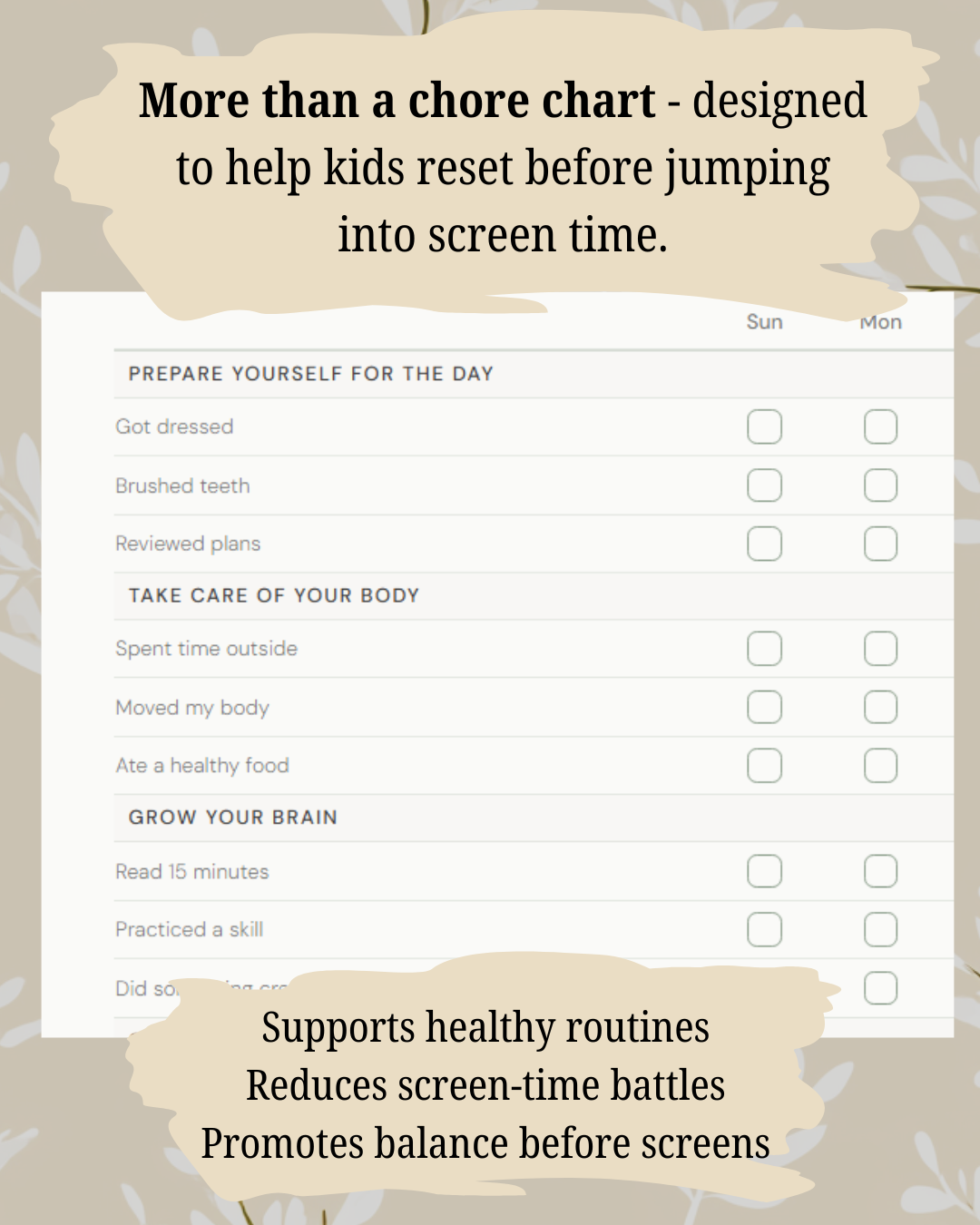
That’s why I became such a big believer in visual systems and checklists.
Not giant overwhelming chore charts.
Not complicated behavior programs.
Just a simple daily reset checklist kids can move through independently before screens enter the picture.
Because checklists do something really important:
They move the responsibility out of the parent’s brain and into the environment.
Instead of:
“Did you go outside yet?”
“Did you drink water?”
“Did you finish your responsibilities?”
“Have you been sitting on the couch for four hours?”
…the checklist becomes the reminder.
Over time, kids stop waiting to be managed.
They start learning the rhythm themselves.
That ownership piece matters a lot.
Kids like knowing what to expect.
They like predictability.
They like feeling capable.
The checklist also removes a surprising amount of mental load for parents.
You no longer have to constantly decide:
“Should I allow screens right now?”
“Have they done enough today?”
“Am I being too strict?”
“Am I being too lenient?”
The system already answered the question.
That’s the magic of good systems:
They reduce the number of decisions everyone has to make.
And because the checklist is visual, it works even when kids are tired, distracted, overstimulated, or rushing through the day.
No lectures required.
No giant power struggles.
No turning screens into the emotional center of the home.
Just a simple reset.
That’s ultimately the goal.
Not raising kids who never use screens.
Raising kids who know how to take care of themselves before they disappear into them.